At the Shoreline
What separates:
fences, seawalls, trunk roads, no-entry signs, flexible container bags, construction panels, monuments.
What trespasses:
salt-tolerant chrysanthemums, graffiti, small altars, flower offerings, birds, anglers.

A Mirror of the Other Shore, 2021
Daguerreotype, wood, metal
18 cm in diameter
A Mirror of the Other Shore
“Excuse me,” the man from TEPCO’s security department began over the phone. “Are you taking photographs right now? We would like you to stop that sort of thing...”
His voice, weak and low, was drowned out by the waves slapping the side of our fishing boat, and reached me only in pieces.
“Are you asking me to stop shooting? I have permission from the Coast Guard.” At this, the man said, “Please hold on, I’ll check with my superior,” and hung up. A few minutes later, the phone rang again, and I heard the same voice.
“I checked with my superior, and he says we are not supposed to say something like that. However, if you could refrain from using a telephoto lens... If the facility appears in the frame, it becomes a security problem, so, you understand, the circumstances...”
Was the man on the line watching us through a telescope from some corner of the plant? Or was he sitting in an office in a big city somewhere, the receiver pressed to his ear, sick of this unwanted task and wishing it would end now? The silence on the other end seemed to lead to a place with no reality, an imaginary one.
“I see. I understand your situation.” That was all I said before hanging up.
Ishida-san, captain of our boat, who had been listening beside me, lit a fresh cigarette. “What the hell. Want me to take you closer?” He put the engine in low gear and brought the boat up near the breakwater.
The Fukushima Daiichi Nuclear Power Station now stood within arm’s reach. The familiar pale blue pattern I had stared at so intently on television. The heavily damaged buildings were under covers, and Unit 4 had been fitted with a support structure for removing nuclear fuel.
When I brought Unit 1 into the telephoto lens, I saw a worker in a white Tyvek suit and a gas mask standing at an opening in the building. He seemed to be staring back at me.
There is a person in there...
The dizzying distance that opens between us and the “other side.” In that place we can never reach, someone’s fragile body has been placed.
— Takashi Arai: One Hundred Suns / One Hundred Mirrors (Iwanami Shoten, 2023)
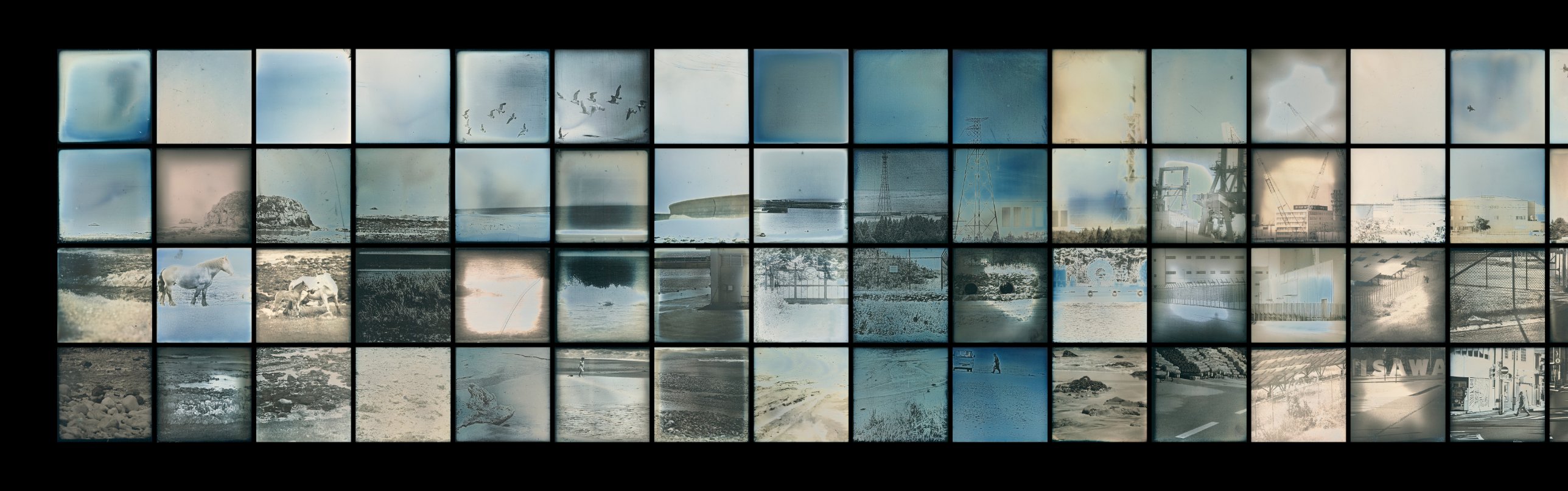
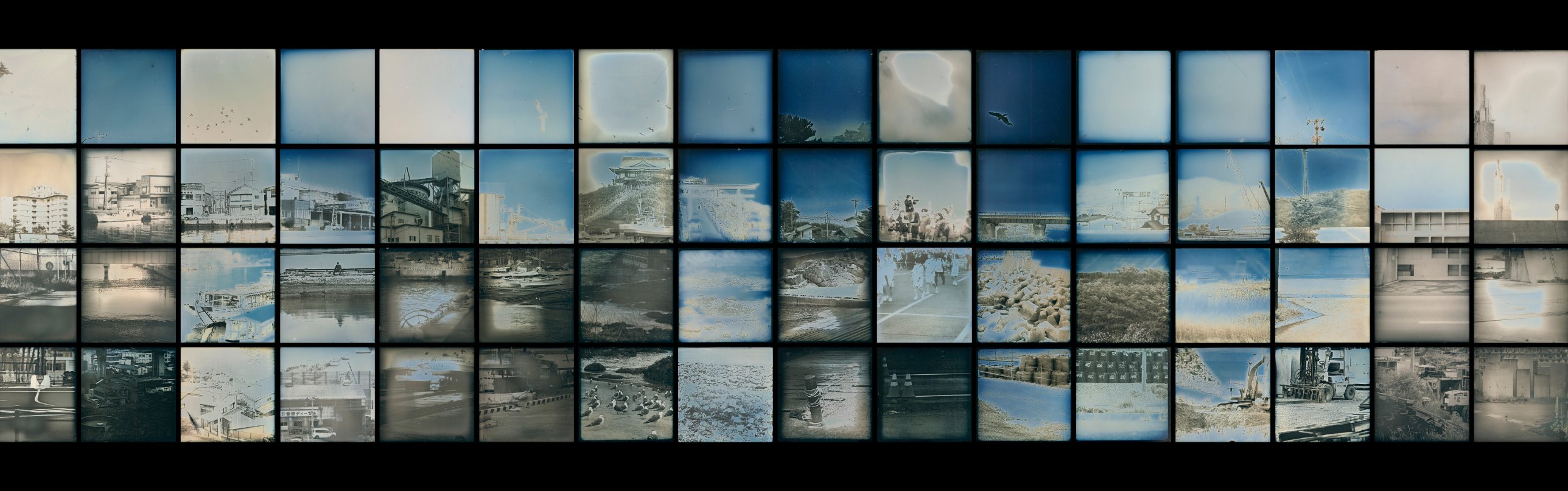
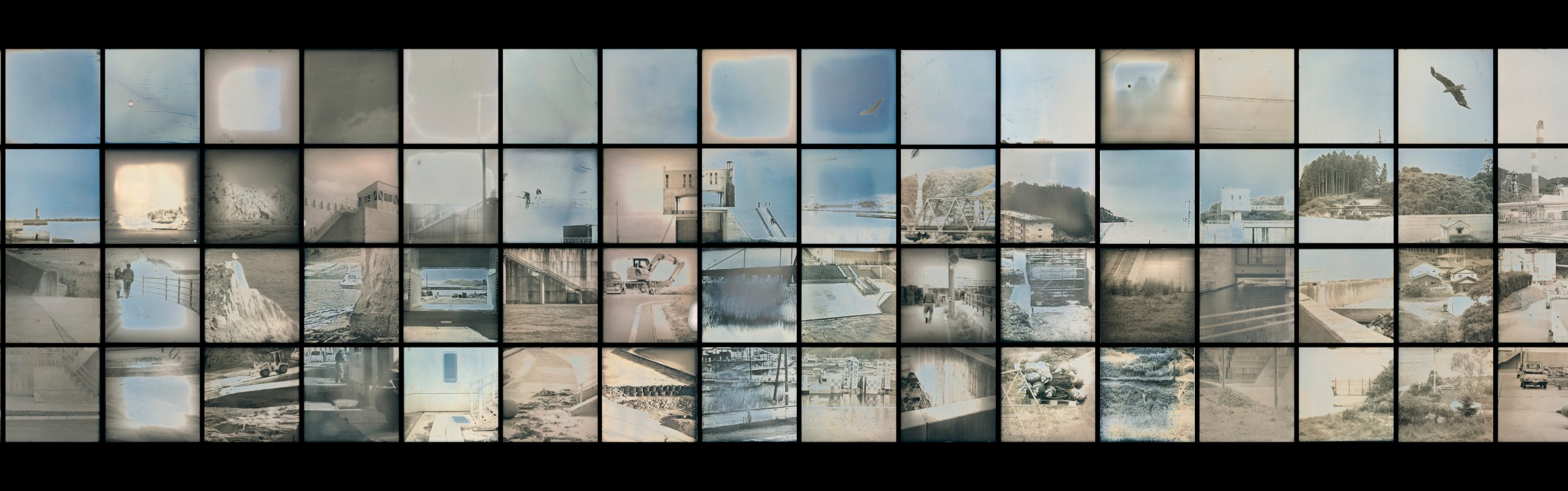
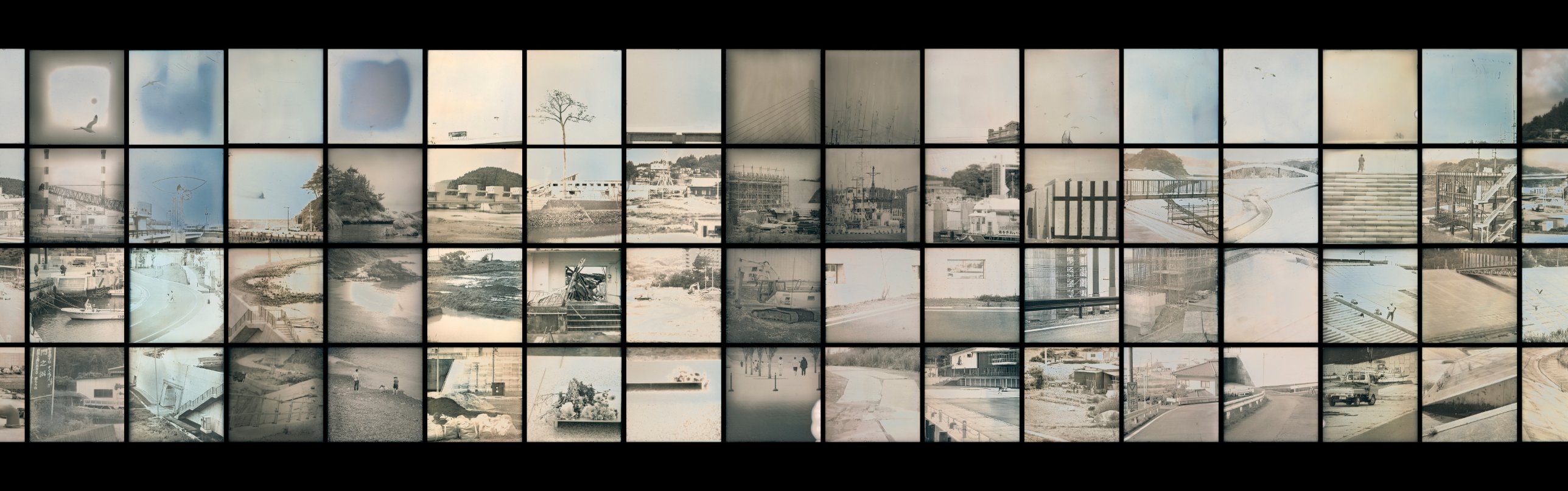
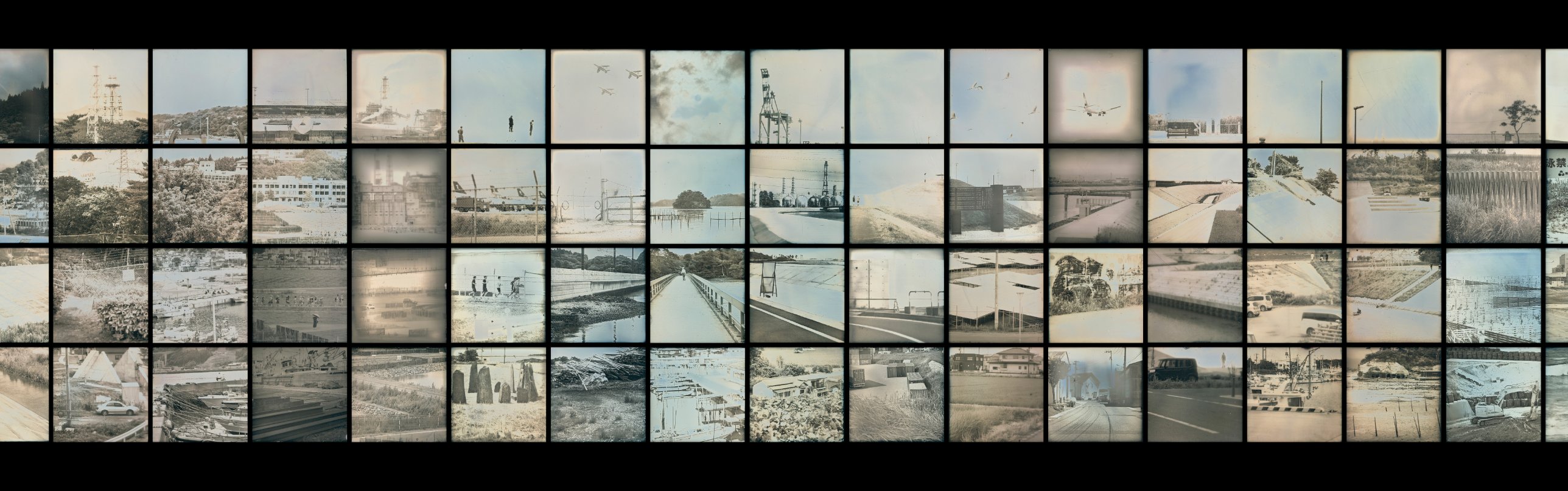
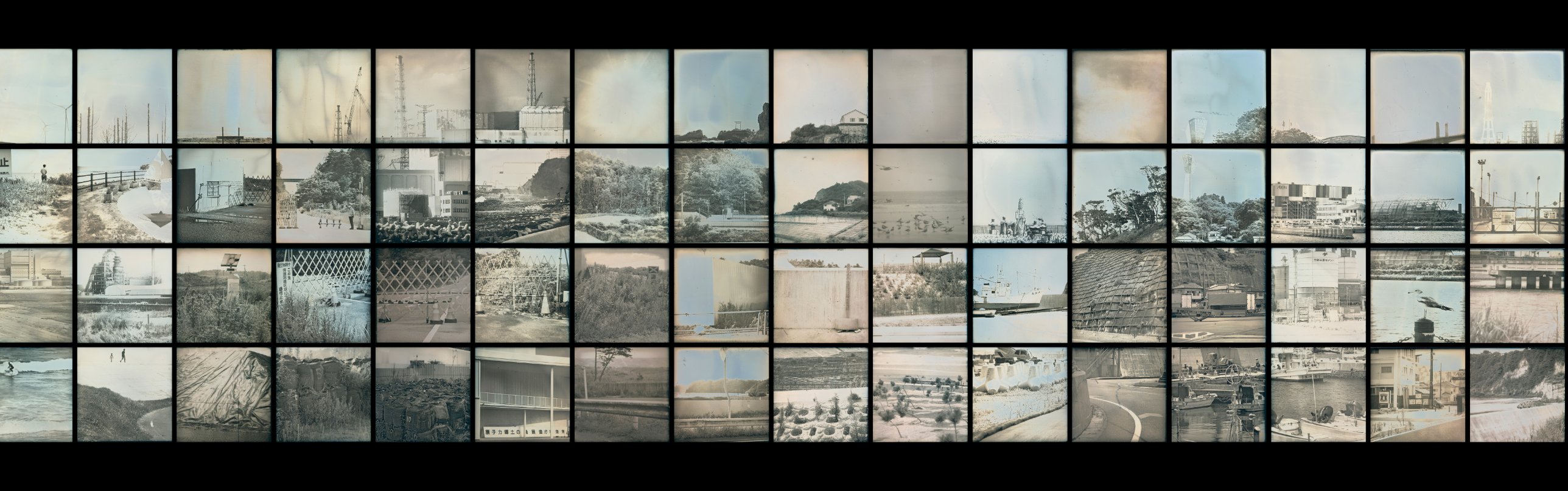
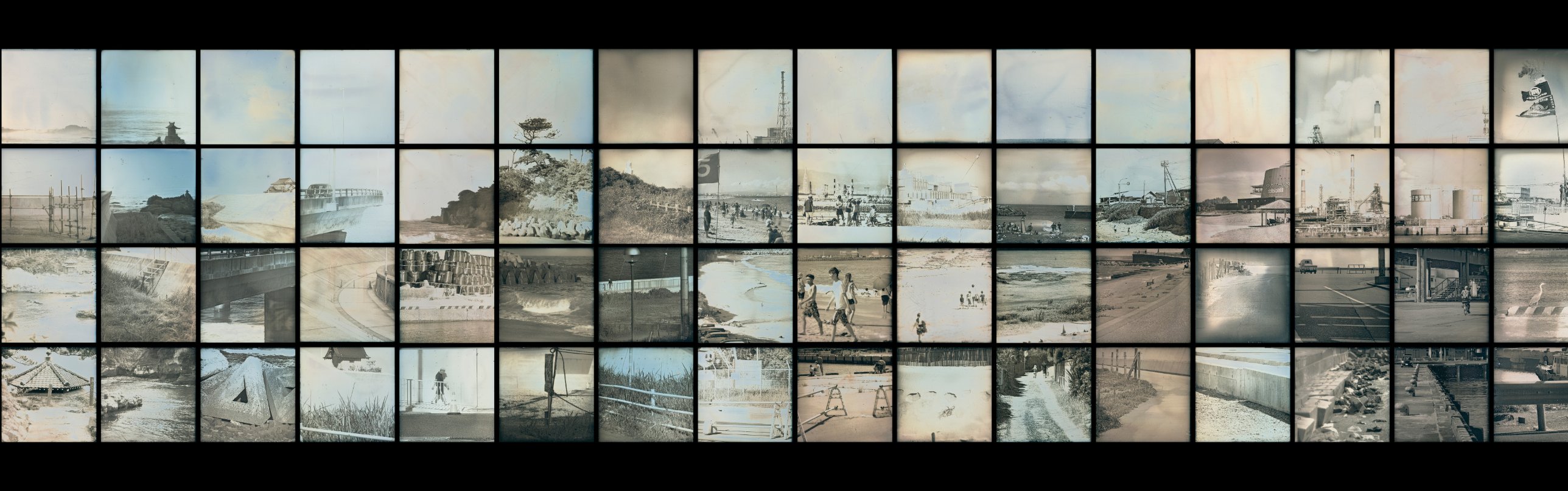
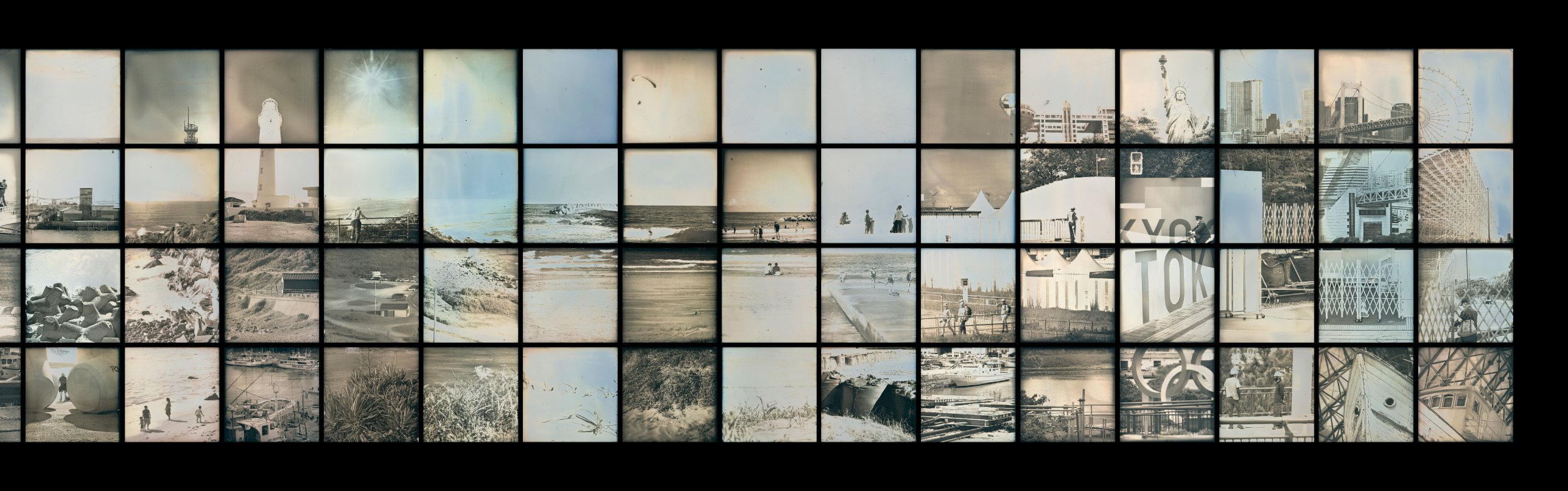
The East Japan Coast Daguerreotype Mural, No.1-5, 2021
Daguerreotype
172.7 × 34.1 × 3.3 cm each
At the Shoreline
The beaches of East Japan are disappearing. Who pays attention to that now?
While society frowned on going out and people hid behind white masks, I set out on a journey along a thousand kilometers of coastline, from Shiriyazaki in the north to Inubosaki in the south. I converted an old microbus into a darkroom and living space and kept moving. A journey in which I met no one had an inhuman quality, like traveling alone in a spaceship across an unknown planet.
Into the sea and sky of Tōhoku, made of pale soda glass, military bases, nuclear power plants and nuclear fuel facilities are suddenly inserted. The coastline that let the water in during the Great East Japan Earthquake has since been covered in concrete without a single gap, from small inlets to second-class rivers. The limestone needed for the seawalls was cut from mountain shadows hidden from the views of the towns, then refined and redistributed. With the supply of gravel and sand from natural rivers cut off, a swarm of brand-new tetrapods stitches the scars of the badly eroded beaches.
The nature of the Japanese archipelago, as the living presence of the Pacific Ring of Fire, is so strong that only those who live on these islands can understand it. If you have ever lived outside a city, you know without having to picture it the summer grass that grows back no matter how many times it is cut, and the clearing of snow from roofs, a labor worthy of Sisyphus.
On that day, the “unforeseen” threat of nature was redefined as something that should have been foreseen, as a contamination to be managed under the control of civilization. So we covered our eyes with gleaming white seawalls, severed our communion with the sea, and decided to erase the beaches from the new maps. This is an outpouring of naked hostility toward nature, one that the people living on these islands had never before put on.
— Takashi Arai: One Hundred Suns / One Hundred Mirrors (Iwanami Shoten, 2023)

Installation view of Takashi Arai: At the Shoreline
Kōjitsutei Teahouse, Chiba Park
Chiba City Festival of Arts, 2021


A Water Harp of 20,000 Years
At an antique shop, I came across a water basin three hundred years old.
Standing now on strata a hundred and twenty million years old, with the sun of eight minutes ago above our heads, we dream of the present.
The future lies so far ahead that we will no longer exist on this earth, yet human desire refuses that fact.
Even so, our season will pass, and the things left behind will begin to speak, at a shoreline where no one is. Steeped in the sound of rain, the rain of radionuclides falling on a planet in lingering dusk.

A Water Harp of 20,000 Years, 2021
Bronze water basin, drip device linked to a Geiger-Müller tube, seven-segment LED
Production support: Tetsuo Kikuta (kWorx)
At the Shoreline
At the Shoreline, 2021
Two-channel video, black and white, 55 min
...Our ears are always pricked toward the same voice.
—Then should human life be treated lightly? Should the weak be abandoned?
We fall silent before the ring of truth in that voice. But whose life is it, living in what place and what time? Which weak ones, in what place and what time? We give up thinking beyond the limited space and time of our own lives, beyond the shell of our imagination.
When we hear a ring of truth even in the words of Anna Tsing, “changing with circumstances is the stuff of survival,” we realize that protecting life and reaching out a hand to the weak was never the same thing as sealing off the water’s edge and wiping out the threat, the contamination, root and branch.
However pure we may wish to be, along with the movement and mingling of people, viruses, knowledge, culture and gazes will wash up on the shoreline, carrying the keys to new hardship and evolution. Along with contamination.
What separates: fences. Seawalls. No-entry signs. Ethnicity and nationality. Religion. Gender. Quarantine. Borders.
What crosses over: gazes. Anglers. Graffiti. Mixed heritage and immigrants. Song. Queerness. Infectious disease. Birds.
Anna Lowenhaupt Tsing, The Mushroom at the End of the World (Princeton University Press, 2015), p. 27
— Takashi Arai: One Hundred Suns / One Hundred Mirrors (Iwanami Shoten, 2023)